Federal agency rules it will not have sole oversight over Lake Powell Pipeline permitting
ST. GEORGE — The federal agency that has been at helm of a permitting process for the Lake Powell Pipeline announced Thursday that is claiming jurisdiction for only a part of the project and not the whole as requested by state and county water managers.
While Lake Powell Pipeline opponents see the ruling as a blow to the project’s progress, supporters see it as a positive as it finally allows the paused project to get restarted.
When the Federal Energy Regulation Commission announced last December it was ready to move forward on an environment study associated with licensing for the project, regulators noted there was a question of jurisdiction.

FERC will oversee the hydroelectric facilities to be built along the pipeline’s course, but not necessarily a part of the pipeline itself. Regulators said it may be the purview of another federal agency.
Read more: Federal agency OKs study, public comment on proposed Lake Powell Pipeline
In January, the Utah Board of Water Resources and Washington County Water Conservancy District asked FERC to pause the permitting process so jurisdiction could be sorted out.
Having received no response by August, the board and water district requested FERC restart the permitting process so no more time would be lost, while also asking for the lingering jurisdiction issue to be resolved.
“The Commission will not act as the ultimate decision maker for approving any portion of the overall project beyond the discrete hydropower facilities,” FERC officials said Thursday in a 31-page document outlining their decision.
A dissenting opinion by commission member Neil Chatterjee said FERC had narrowly interpreted the agency’s authority to oversee an entire project and listed other water infrastructure projects the agency had overseen that included the piping system.
“I believe that, in this case, the majority is misguided in its narrow interpretation of what facilities should be included in the hydroelectric facilities of the Lake Powell Project,” Chatterjee wrote.
FERC remains in charge of the project’s environmental impact study.
Opponents to the Lake Powell Pipeline such as Gary Wockner of Save the Colorado are pleased with the jurisdiction announcement.
“FERC made the correct, legal decision with this denial,” Wockner said. “This is a massive, environmentally destructive water and pipeline project on the extremely endangered Colorado River – not simply an ‘energy’ project – and it will require a full Environmental Impact Statement process from another appropriate federal agency.”
While the introduction of oversight by other agencies could have the potential to delay certain elements of the pipeline, supporters see the announcement as a step forward for a project that had been stuck in limbo.
“We’re grateful to have a decision from FERC,” said John Fredell, Lake Powell Pipeline program director. “The decision clarifies the scope of authority with all the involved federal and state agencies and will allow us to expeditiously move this critical project through the environmental review.”
Ron Thompson, general manager of the Washington County Water Conservancy District, called FERC’s decision “a plus.”
“We’re glad to have a ruling so we know who all the players are,” Thompson said. “This settles who does what and allows the environmental (study) process to move forward.”
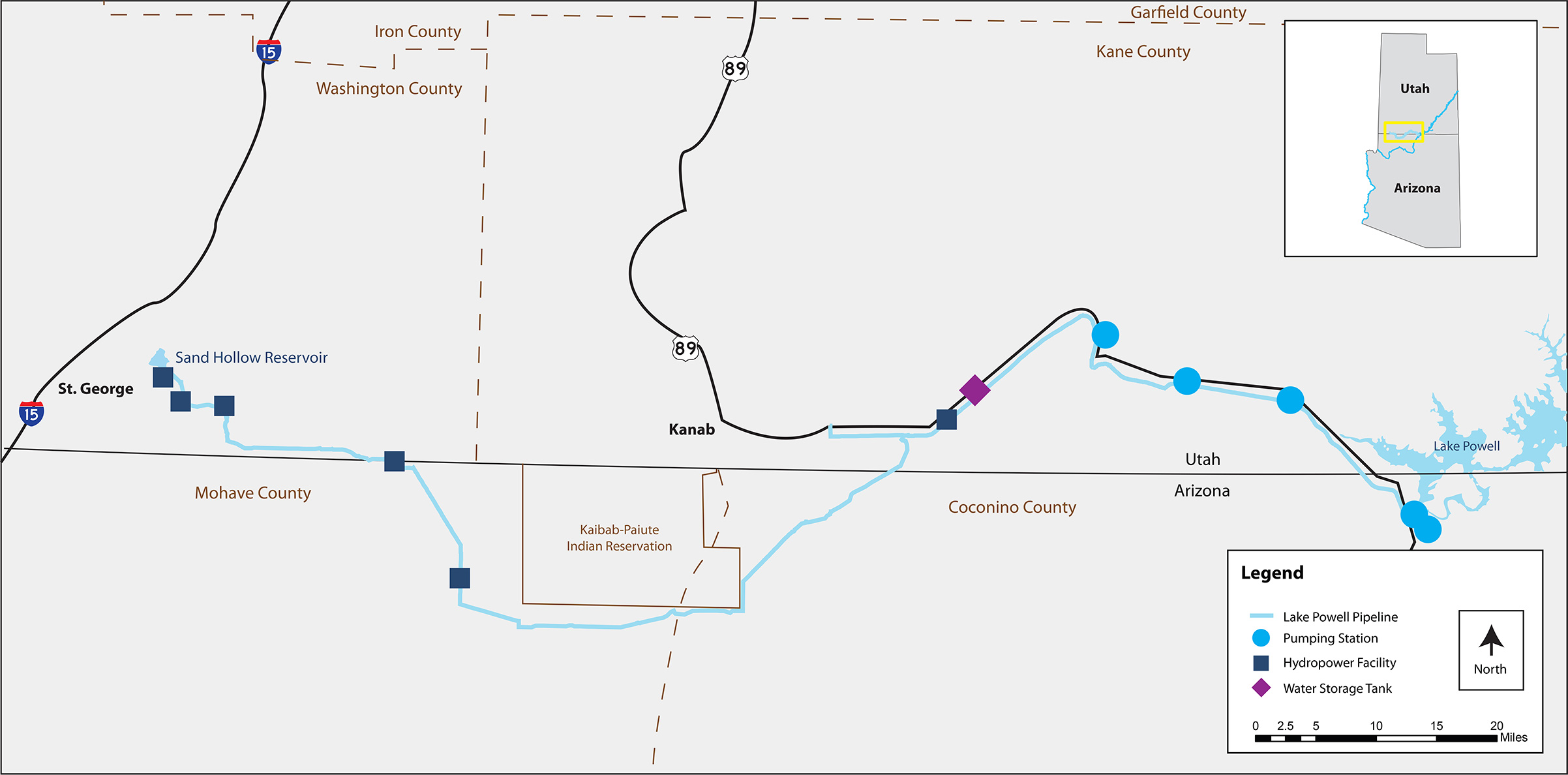
The proposed 140-mile long, 70-inch diameter pipeline is designed to take water from Lake Powell to Sand Hollow reservoir in Washington County. The pipeline is anticipated to bring 77 million gallons of water daily to 13 communities in Washington and Kane counties.
The proposed course of the pipeline snakes along the Utah-Arizona border and runs through both public and private lands.
Communities in Washington County get their water from a single source: the Virgin River. State and county water planners have said for years that the county needs to diversify its water resources, especially in light of expected growth in population.
Washington County is projected to have a population of 500,000 over the next 50 years. The water district has said the development of current water resources and conservation will only be able to make up a little over half of the water supply needed to sustain a population of that size. The Lake Powell Pipeline, water district officials say, will be able to supply the rest.
Email: mkessler@stgnews.com
Twitter: @MoriKessler
Copyright St. George News, SaintGeorgeUtah.com LLC, 2018, all rights reserved.